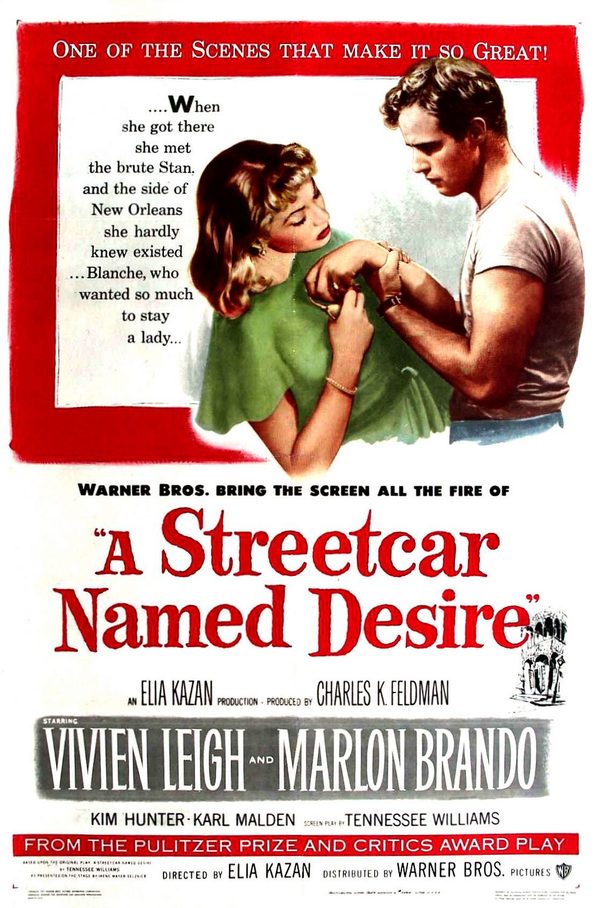
A Streetcar Named Desire (1951) on Netflix
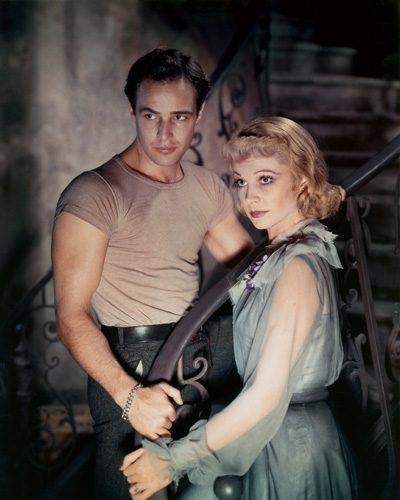
Blanche DuBois arrives in New Orleans to stay with her sister Stella Kowalski and Stella's husband, Stanley. His crude ways clash with her manner, and he questions her about the family estate.
- Netflix3.7/5
- IMDb7.9/10119,688 votes
- Rotten Tomatoes97%
Trailer

Plot summary
Blanche DuBois, who taught English at a high school in Auriol, Mississippi, comes to New Orleans and rides the streetcar marked Desire into the French Quarter. Her sister Stella lives there with her husband, Stanley Kowalski, in a cramped apartment in a run-down building. Blanche says she has taken leave from her job because of anxiety. Her careful manner is a sharp contrast to Stanley's rough behavior, and the two of them regard each other with suspicion from the beginning. Blanche tells them that the family estate, Belle Reve, has been lost to creditors; when Stanley hints that she may be concealing money, she produces the papers proving the foreclosure. Stella is pregnant, and Blanche meets Mitch, a friend of Stanley's whose polite, gentle way sets him apart from Stanley's other companions.
Cast








- Ann Dereas The Matron
- Edna Thomasas The Mexican Woman



Show all 20 cast
- Mel Archeras Foreman (uncredited)
- Walter Baconas Club Patron (uncredited)



- John Gonetosas Vendor (uncredited)
- Chester Jonesas Street Vendor (uncredited)



Did you know?!Facts and trivia about A Streetcar Named Desire (1951)
Can contain spoilers, watch the movie first.
- Elia Kazan wanted Jessica Tandy, who had won a Tony as Blanche on Broadway, to repeat the role on film, but producer Charles K. Feldman demanded a bigger box-office name. Bette Davis and Olivia de Havilland both declined, and the part went to Vivien Leigh, who had played Blanche in London for her husband Laurence Olivier.
- The Kowalski apartment was not a fixed set. It was built to appear gradually smaller as the film goes on, closing in on the characters to mirror the tension between them.
- Scenes were cut from the finished film to satisfy the Hays Code and head off condemnation by the National Legion of Decency. The censored footage turned up in a routine Warner Bros. archive inventory in 1993 and was restored for an original director's version release.
SPOILER
The Hays Code forced a rewrite of Blanche's back story. In Tennessee Williams's play her husband kills himself after being found in a homosexual affair; the film drops that, and Blanche says instead that her scorn for his sensitive nature drove him to it.- The film set an Oscar record as the first to win three of the acting categories, a feat matched only by Network in 1976 and Everything Everywhere All at Once in 2022. It was also the first Warner Bros. picture since Anthony Adverse in 1936 to take four or more Academy Awards.
- Blanche only hears about the Desire streetcar in the play, but the film shows her riding it. By the time of production the Desire line had been handed over to buses, so the crew had to get permission from the authorities to hire out a streetcar carrying the Desire name.
- Alex North wrote the score as short jazz-inflected cues keyed to the characters' psychology. It was one of the first jazz scores composed for a mainstream feature film, and it brought North an Oscar nomination for Best Original Score.
- Streetcar number 922 was picked to drop Blanche off in the opening scene. More than seventy years later, as of 2022, the same car was still in service on the St. Charles Streetcar Line in New Orleans.