Trailer

Plot summary
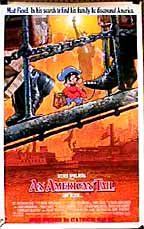
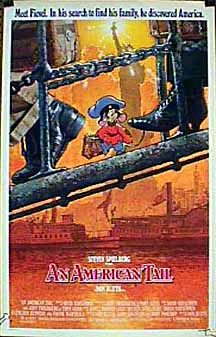
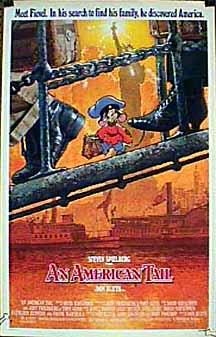
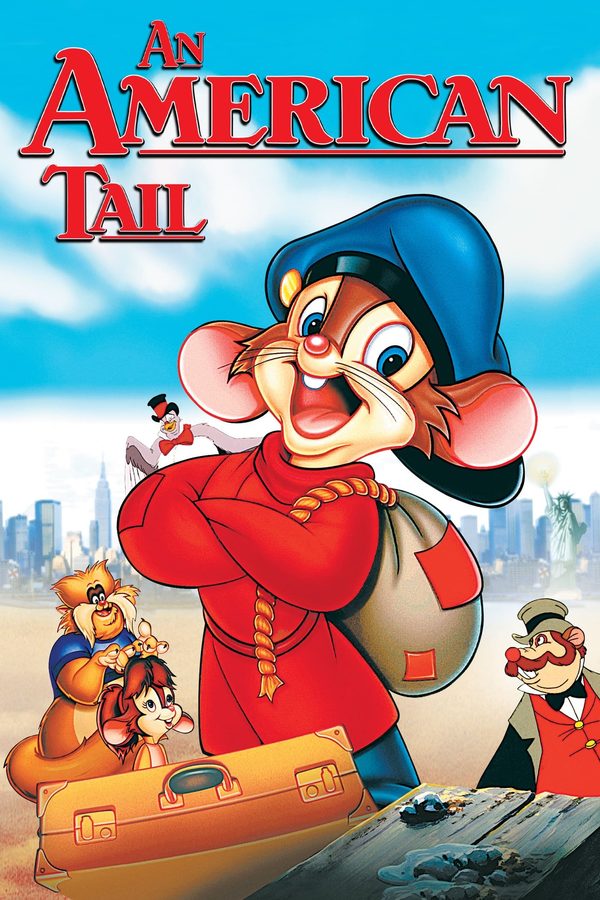
In Shostka, in the Russian Empire, the Mousekewitzes are a family of Jewish mice living beneath a human household. On Hanukkah, Papa gives his son Fievel a kashket and tells him of America, a country he believes has no cats. Cossacks ride through the village and their cats attack, destroying the mice's homes, and the family flees, boarding a steamer in Hamburg for New York. A thunderstorm separates Fievel from his parents and sister; his family sails on believing he is lost, while he floats to New York in a bottle. Encouraged by Henri, a French pigeon, Fievel sets out to find them, and on the streets he falls in with Tony Toponi and Bridget, an Irish mouse who speaks out against the city's cats.
Cast


- Amy Greenas Tanya Mousekewitz (voice)









Did you know?!Facts and trivia about An American Tail (1986)
Can contain spoilers, watch the movie first.
- Don Bluth thought "Fievel" was too foreign-sounding for audiences to remember, but Spielberg, who named the mouse after his maternal grandfather, won the argument. The scene of Fievel at a classroom window came from the grandfather's account of Jews listening to lessons through open windows from the snow outside.
- Art Spiegelman accused Spielberg of plagiarism for depicting Jews as mice, the metaphor of his own Maus. Rather than sue, he beat the film to the shops, persuading his publishers to split Maus into two volumes and put out the first before he had finished the second.
- Bluth took the film on for $6.5 million, later $9 million, at a time when Disney was spending around $12 million per animated feature. To make the sum work his employees agreed to have their salaries frozen for a year and a half.
- The new Sullivan Bluth studio was non-union, and when many of its workers tried to withdraw from the union it set off a battle with Bluth that ran through most of the production. That struggle was the main thing that later drove him to move to Ireland.
- Cel painting was already being done in Ireland and there was talk of moving the entire production there, but Spielberg balked at the idea of a story called An American Tail being made overseas.
- On its domestic release it became the highest-grossing animated feature for an initial release and the highest-grossing animated feature not produced by Disney, and one of the first animated films to outdraw a Disney one, beating The Great Mouse Detective by over $22 million.
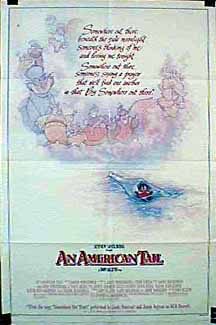
- "Somewhere Out There", sung by Linda Ronstadt and James Ingram, outgrew the film: it won two Grammy Awards, Song of the Year and Best Song Written Specifically for a Motion Picture or for Television, and became one of the most popular songs from an animated feature since the 1950s.
- Fievel outlived his own film. He became the mascot of Spielberg's Amblimation studio in London, appearing in its logo until DreamWorks Animation replaced it in 1997, and in March 2000 he was made UNICEF's official children's spokesman.