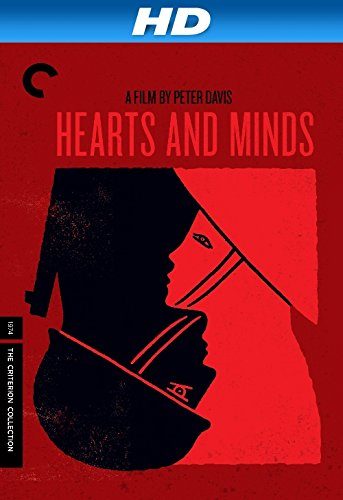
Hearts and Minds (1974) on Netflix
R19741h 52mDocumentaryWar
President Lyndon B. Johnson said victory in Vietnam depended on the support of the people who lived there. Generals, officials, veterans and Vietnamese speak as the war continues.
- Netflix3.8/5
- IMDb8.2/106,677 votes
- Rotten Tomatoes90%
Trailer

Plot summary
The documentary was made and shown before the Vietnam War ended, and it sets interviews against wartime footage. The speakers include the general who commanded American operations in Vietnam, civilian advisers, senators, anti-war veterans and activists, and Vietnamese voices such as a coffin maker, former political prisoners and a refugee. Accounts of the war and of the part the United States played in it disagree sharply. A naval aviator held for years as a prisoner of war is shown at a homecoming parade in his New Jersey hometown and at a school assembly. Combat footage and its aftermath, among them the burial of a South Vietnamese soldier and a girl burned by napalm, are cut against what the speakers say.
Cast
- Clark Cliffordas Self - Aide to President Truman 1946-50

- Georges Bidaultas Self - French Foreign Minister in 1954
- George Cokeras Self - Prisoner of War 1966-73
- Walt Rostowas Self - Aide to Presidents Kennedy, Johnson
- J. William Fulbrightas Self - Senator
- Randy Floydas Self - Former Navy Captain


Show all 20 cast
- Charles Hoeyas Self - U.S. Air Force, Saigon
- Jerry Holteras Self - U.S. Air Force, Saigon
- Stan Holderas Self - Former Corporal
- Bobby Mulleras Self - Former 1st Lieutenant


Did you know?!Facts and trivia about Hearts and Minds (1974)
Can contain spoilers, watch the movie first.
- Accepting the Academy Award for Best Documentary, Feature on April 8, 1975, co-producer Bert Schneider read a telegram of "Greetings of Friendship to all American People" from the Viet Cong delegation to the Paris Peace Accords; Frank Sinatra later read a letter from Bob Hope saying the academy was not responsible for political references on the program.
- General Westmoreland's line, "The Oriental doesn't put the same value on life", reached the screen on a third take: after the first he said he had expressed himself inaccurately, and the second ran out of film. Peter Davis said that rather than argue with him he just wanted to draw him out.
- Commercial distribution was delayed in the United States by legal issues, including a temporary restraining order obtained by one of the interviewees, former National Security Advisor Walt Rostow, who claimed through his attorney that the film was "somewhat misleading" and "not representative" and that he had not been given the opportunity to approve the results of his interview.
- Michael Moore has cited Hearts and Minds as the one film that inspired him to become a filmmaker, calling it "not only the best documentary I have ever seen...it may be the best movie ever"; many of its cinematic techniques are similar to Moore's 2004 documentary Fahrenheit 9/11.
- When Columbia Pictures refused to distribute the picture, producer Bert Schneider went to Henry Jaglom to purchase back the rights, and released the film in March 1975 through Warner Bros.